


How to Check Directions in Your House (Compass Guide)

Updated: Aug 1
If you're trying to figure out how to check directions in your house, you're probably after one of two things: which way your house faces, or which direction each room falls in. This guide walks you through both the right way, so you're not basing anything on a reading that's quietly off by a few degrees.
Most guides stop at "open a compass app." We won't. A few small steps make the difference between a reading that looks right and one that actually is.
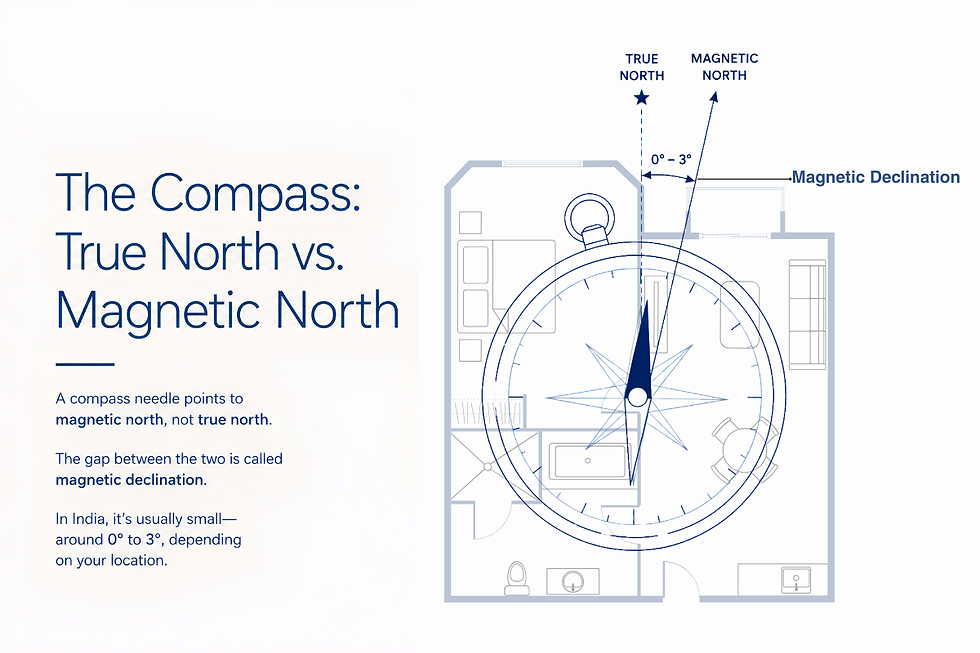
The Compass: True North vs. Magnetic North
A compass needle doesn't point at true north, the Earth's actual geographic pole. It points at magnetic north, which is a slightly different spot that shifts over time. The gap between the two is called magnetic declination, and in India it's usually small, roughly 0° to 3° depending on where you live.
Small, but not nothing. Vastu splits a house into narrow zones, some as tight as 22.5°. A reading that's off by even 2 or 3 degrees can push an entrance or a corner into the wrong zone entirely, with a different set of recommendations attached to it. So before anything else: correct your reading for declination, using a tool like NOAA's magnetic declination calculator. It's a one-time lookup for your city, and it's the single most important thing in this whole guide.
How to Check Directions in Your House
Set up your compass: Grab a compass app or a physical compass, and keep it away from metal, magnets, and other devices nearby, they can throw the reading off.
Correct for declination: First, take your compass reading as shown. Then look up the declination value for your city and apply it to that reading, most phone apps display the raw (magnetic) reading without correcting it automatically.
Stand at the center of your house: This is the Brahmasthana, not the doorway or a random room, and it's the point every directional zone in the building is measured from. Take three readings a few seconds apart and average them; a single reading can drift off from a small hand movement. If your plot isn't a regular rectangle, draw the smallest rectangle that fully contains your building's footprint, and use its center instead.
Read your facing direction: Face your main entrance from that center point and read the bearing. That number, corrected for declination, is your house's facing direction.
If you want to know what different facing directions actually mean for your home, we've broken that down separately in North vs South Facing House: According to Vastu.
Understanding the Eight Directions (and the Center) of a Home
This directional breakdown comes from the Vastu Purusha Mandala, the grid Vastu Shastra is built on. If you're curious how that grid is actually constructed, we've covered it in What Is Vastu Shastra. For now, here's what each direction represents, and why it's more than just tradition.
North (Uttara): Kubera's Quarter
Associated with Kubera, the keeper of wealth, and with stability and accumulation. The northern face of a building in tropical India receives diffused light year-round without direct solar exposure, making it a calm zone for storage, study spaces, or valuables.
North-East (Ishanya): Shiva's Corner
Considered the most sacred direction in Vastu, associated with purity and spiritual clarity. It receives the first, gentlest morning light and cooler overnight air, which is why texts reserve it for the puja room, water source, or meditation space, kept open and free of heavy structures.
East (Purva): Indra's Gateway
The direction of the rising sun and of beginnings, Indra's domain. Rooms that open east receive direct morning sunlight, which peer-reviewed sleep research links to better sleep quality and faster sleep onset. The classical preference for east-facing living spaces holds up well against that evidence.
South-East (Agneya): Agni's Hearth
Belongs to Agni, the fire god, and is the traditional placement for the kitchen. It receives morning solar warmth without the punishing afternoon heat load of a west or south exposure, a genuinely practical answer for cooking spaces in the Indian climate.
South (Dakshina): Yama's Ground
Yama's territory, associated with structure, weight, and consequence. This face receives the most intense solar radiation of any facade and, in many northern Indian cities, faces incoming summer dust storms. The prescription for heavy walls and minimal openings lines up with straightforward climate logic.
South-West (Nairitya): The Corner of Weight
Considered the heaviest, most grounded direction, traditionally the location of the master bedroom. It's also the last part of a building to lose the sun's heat in the evening, making it the most thermally stable zone overnight, a reasonable basis for placing the room where the household sleeps.
West (Paschima): Varuna's Domain
Associated with Varuna and the day's end. It catches the afternoon sun, intense in summer, longer in winter, and its classical association with water made it a natural placement for bathrooms and evening sitting areas.
North-West (Vayavya): Vayu's Gate
The domain of Vayu, the wind god, and the direction prevailing winds enter from through much of the Indian subcontinent. Traditionally reserved for guest rooms, spaces that benefit from good airflow without long-term thermal or acoustic stress building up.
Brahmasthana (Center): The Heart of the Grid
Not a direction in the compass sense, but it's part of the same grid, so it earns a place here. The Brahmasthana is the central block of the mandala, traditionally considered the dwelling of Brahma and the point every other zone radiates from. Classical guidance keeps this space open and unobstructed: no heavy pillars, beams, staircases, or toilets over it, ideally left as an open courtyard, hall, or lightly used common space that lets the rest of the home breathe.

Common Mistakes When Checking Directions at Home
A few errors show up again and again, and most of them are avoidable:
Skipping declination correction: using a raw magnetic reading and treating it as true north
Taking the reading near interference: phones, jewellery, steel furniture, or rebar in flooring can all pull a needle off
Relying on a single reading: a compass reading can drift by a degree or two just from hand movement; always take and average three
Misjudging the center on an irregular plot: trying to eyeball the center of an L-shaped or cut-corner plot instead of using the smallest containing rectangle
Confusing entrance orientation with facing direction: the direction a door faces and the direction the building itself faces aren't always the same thing on an angled or corner plot
FAQs on Checking Directions in Your House
How many compass readings should I take?
At least three, a few seconds apart, then average them. A single reading is more vulnerable to small errors from hand movement or nearby interference.
Is a phone compass accurate enough for Vastu purposes?
Yes, provided you take the raw reading first and then correct it for declination, and keep the phone away from magnetic interference (cases, other devices, jewellery). Most apps display magnetic north rather than true north, so check which one yours is showing before applying the correction.
What if my plot isn't a perfect rectangle?
Draw the smallest regular rectangle that fully contains your building footprint, and use its center as your reference point instead of the irregular plot's visual center.
Does magnetic declination really matter for a home in India?
Yes. Declination in India can run from roughly 0° to 3° or more depending on location, and Vastu's directional grids use zones as narrow as 22.5°, so a small uncorrected error is enough to shift a classification.
Is checking my entrance direction the same as mapping directions for every room?
No. Your entrance direction tells you how the building faces the world. Each room and corner has its own direction too, based on where it falls in the grid, which is why the Brahmasthana center point matters just as much as the front door.
Key Takeaways
A compass points to magnetic north, not true north; the gap between them is magnetic declination
Correct for declination before using any reading for Vastu or directional analysis
Always take your reading from the centre of the house (Brahmasthana), not the doorway
Take three readings and average them; a single reading is easy to throw off
Each of the eight directions carries a climate-based logic, not just a symbolic one
Conclusion
Knowing how to check directions in your house correctly takes a few extra minutes: a declination lookup, three readings instead of one, standing at the right point in your house. But it's the difference between a reading that's actually accurate and one that only looks precise. Get this right, and everything you do next, from entrance placement to room layout, stands on solid ground.
If you'd rather have this checked professionally, especially on an irregular plot or an older building where the original orientation isn't obvious, it's worth booking a consultation with a Hourly.Design Vastu expert, or reading our companion guide on North vs South Facing House: According to Vastu for a deeper walkthrough of that step.

Comments