


North vs South Facing House: Which Is Better?

Updated: Jul 31
If you've been house-hunting or planning a build, you've probably heard some version of this: "Never buy a south-facing house" or "North-facing is the only safe choice." It's one of the most repeated pieces of advice in Indian real estate — and also one of the least explained.
The truth is, when it comes to a north vs south facing house, the answer isn't as one-sided as most people make it sound. Vastu has genuine reasoning behind its preferences, but there's also real science — sunlight, heat, and airflow — that explains why one direction can feel more comfortable than another in daily life. Understanding both sides is what actually helps you make a confident decision, whether you're evaluating a plot, a flat, or a house you already own.
Before we get into the comparison, it helps to know exactly what you're dealing with. If you're unsure how to check this correctly, or want a proper assessment before making a decision, it's worth speaking with an experienced Vastu consultant who can evaluate your home's layout and orientation in detail.
How to Identify Your House's Facing Direction
This trips up more people than you'd expect, and it's rarely about inside vs. outside — it's about exactly where you stand and how precisely you align yourself. Your compass only tells you the direction you're facing, so if you're standing off to one side of the door, or slightly angled instead of squarely facing through it, you'll get your own orientation, not the house's.
Here's the accurate way to do it:
Stand squarely at the threshold of your main door, centered — not off to one side.
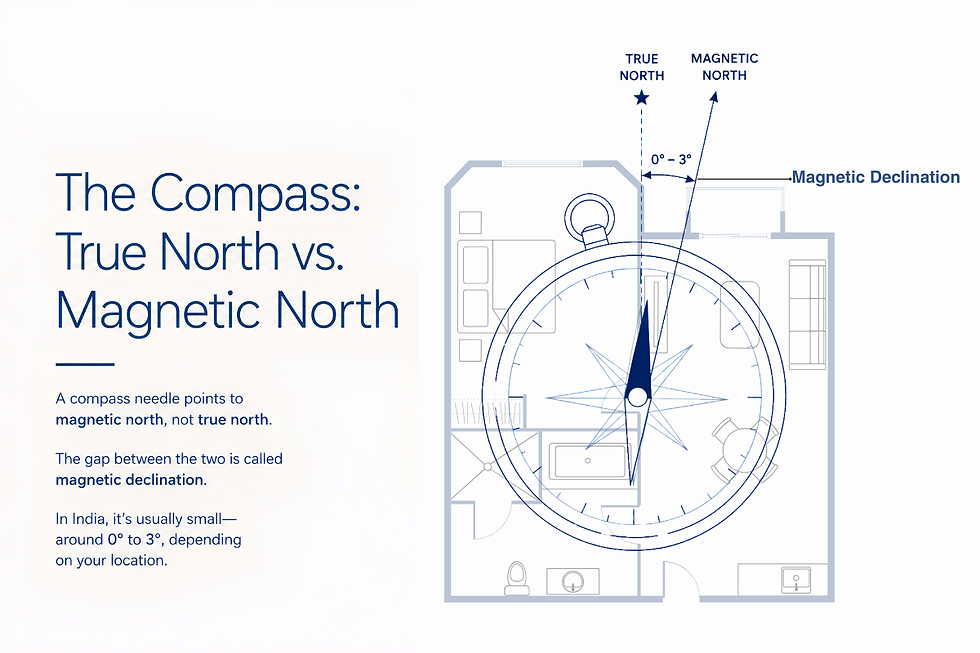
Open a compass app on your phone, and if it has the option, switch it to show true north rather than magnetic north (most apps default to magnetic north, which can be slightly off from true north depending on your location). Learn more about how to check directions in your house
Align your body straight through the doorway, facing the exact direction you'd walk if stepping outside.
Note the direction shown — that's your house's facing direction.
A north-facing house has its main entrance opening toward the north. A south-facing house has its entrance opening toward the south. It genuinely is that simple — the confusion usually comes from mixing this up with which direction your windows or backyard face.
What Vastu Says About North-Facing Houses
North-facing houses are widely considered one of the most favorable options in Vastu Shastra. North is associated with Kubera, the deity of wealth, which is why a north-facing entrance is often linked to financial growth and prosperity.
Beyond the symbolism, a north-facing house as per Vastu tends to work well because:
The main door and central spaces can receive gentle, indirect daylight for most of the day
It supports balanced energy flow when the northeast corner (Ishanya) stays open and light
It's traditionally recommended for people in business, trade, or wealth-focused roles
That said, direction alone isn't a guarantee — poor entrance placement, layout, or staircase position can offset these benefits. And not every north-facing entrance is equally favorable — more on that shortly.

What Vastu Says About South-Facing Houses
South-facing homes carry a reputation that's more myth than fact. In Vastu, south is associated with Yama, the deity of death, which historically created hesitation around south-facing entrances.
But Vastu was never about labeling a direction as permanently "bad" — it's about designing with its characteristics. A south-facing house as per Vastu can work well when a few things are handled correctly:
The main entrance sits in an auspicious zone within the south wall, not just anywhere
Heavier structural elements are positioned toward the south and southwest
Water bodies, kitchens, and lighter spaces are placed in the north or east
South-facing plots are also often larger or more affordable simply because of the stigma — so a well-planned south-facing home can offer real value. And it has its own pada nuance too, which we'll unpack next.
Not Every North or South Entrance Is Equal: Understanding Padas
Here's a detail most house-facing guides skip entirely, and it's the key to understanding why some homes work better than others even when facing the same direction. In Vastu, the full boundary of a plot spans 360 degrees, split evenly across the four cardinal directions — 90 degrees each. Each of those 90-degree stretches is further divided into 8 equal padas of about 11.25 degrees. That's 32 padas in total, and where exactly your main entrance falls within one of those 11.25-degree zones matters just as much as which direction it's on.
North Wall: The Favorable Padas
On the north wall, 3 of the 8 padas are considered favorable for a main entrance:
Mukhya (N3) — associated with overall auspiciousness and fulfillment of the household's wishes
Bhallat (N4) — linked to the deity of abundance, believed to bring wealth, inherited property, and new opportunities
Soma (N5) — connected to the moon, associated with calm, spiritual growth, and mental clarity
This is part of why north-facing houses carry such a strong reputation — with 3 of the 8 padas considered auspicious, the odds of landing on a favorable entrance are simply better.
South Wall: The Favorable Padas
On the south wall, 2 of the 8 padas are considered favorable:
Vitatha (S3) — believed to bring prosperity and success, particularly for effort-driven work
Grihrakshita (S4) — considered the strongest entrance in the south, associated with prosperity, fame, and protection for the household
So a south-facing entrance isn't automatically unfavorable — it depends heavily on which of the 8 padas it actually falls into.
East and west walls follow the same structure — 8 padas each, with a couple of favorable positions in every direction.
The bigger picture here: every direction, north included, has both favorable and unfavorable padas — it's just the ratio that shifts slightly from one direction to another. No direction is entirely "safe" or entirely "risky" by default. This is exactly why a professional Vastu assessment of the exact entrance position matters more than judging a house by its general facing direction alone. (Source: SecretVastu.com)
Beyond Vastu: What Actually Affects Comfort
This is the part most Vastu-only guides skip, and it's arguably more useful for daily living than symbolism alone. India sits in the Northern Hemisphere, so the sun spends most of the day in the southern part of the sky — which is why south-facing homes receive more direct, intense sunlight and heat gain, especially in the afternoon, while north-facing homes stay cooler with more even daylight through the day. Research on daylighting design in India backs this up, showing that north-facing walls generally produce steadier, lower-glare light than east or west-facing ones. (Source: Khaire, Engineering Reports, Wiley, 2026)
More heat gain doesn't automatically mean a worse home — it depends on your climate and how the house is designed. India's Energy Conservation Building Code accounts for five distinct climate zones across the country (Hot Dry, Warm Humid, Temperate, Composite, and Cold) and requires passive strategies like shading and daylighting, since the ideal orientation genuinely changes depending on where you live (Source: Bureau of Energy Efficiency, ECBC 2017). That's why a south-facing house in a cold hill region can actually be an advantage — more natural warmth, lower heating costs — while the same orientation in a hot, dry city like Jaipur or Nagpur will likely mean higher cooling bills unless the design compensates with shading, insulation, and smart window placement.
North vs South Facing House: Side-by-Side Comparison
Factor | North-Facing House | South-Facing House |
Vastu Perception | Favorable; linked to wealth (Kubera) | Needs care; linked to Yama, but fully correctable |
Light & Heat | Soft, even daylight; stays cooler | Strong, direct sun; more heat gain |
Ideal Climate | Hot and composite zones | Cold and hill regions |
Plot Value | Often priced at a premium | Often larger or more affordable |
Fixable by Design? | Rarely needs correction | Yes — with entrance and layout planning |
Vastu Remedies for a South-Facing Home
If you already own, or are considering, a south-facing house, here are practical, widely recommended Vastu remedies that don't require structural changes:
Entrance placement: Where possible, position the main door within the south wall's favorable padas — Vitatha (S3) or Grihrakshita (S4) — rather than the center or corner
Color balance: Use warm, energizing tones — red, orange, coral, or terracotta — on south-facing walls to align with the Mars and fire energy associated with this direction, rather than cool blues or greens, which are considered a clash
Mirror placement: A mirror on the north-facing interior wall is traditionally used to symbolically "extend" wealth energy into the home
Plants at the entrance: Tulsi or money plants near a south-facing entrance are commonly recommended to balance energy
Heavy furniture placement: Keep wardrobes, storage units, and heavier furniture along the south and southwest interior walls, in line with traditional Vastu structuring
Kitchen positioning: Ideally place the kitchen in the southeast corner of the home, regardless of the main facing direction, since this is considered favourable for the fire element in Vastu
Every home is different, and these remedies work best when tailored to your specific layout — so it's worth getting a professional opinion, like booking a consultation with a Hourly Design Vastu expert, before applying any of them rather than following advice you've simply heard elsewhere.
Common Mistakes People Make When Judging a House by Direction
Judging the house by direction alone, ignoring the layout. A north-facing house with a poor internal layout can feel worse than a well-designed south-facing one.
Confusing "facing direction" with "backyard direction." As covered earlier, only the entrance direction counts.
Assuming Vastu remedies are complicated or expensive. Most fixes are simple placement and design choices, not construction projects.
Ignoring the local climate. What works in Delhi's heat won't necessarily suit Shimla's cold, regardless of what Vastu recommends in general terms.
Overlooking window and room placement. Two houses facing the same direction can perform completely differently based on where the windows, kitchen, and bedrooms sit.
Assuming every entrance on the same wall behaves identically. A south wall has 8 possible entrance zones (padas), and only two of them are considered favorable — treating the whole wall as one verdict misses this nuance entirely.
Why Design Matters More Than Direction Alone
Here's the honest takeaway: house facing direction is one input into a much bigger design equation — not the whole answer. A skilled architect or Vastu consultant can often achieve better comfort, better energy flow, and better long-term value through smart layout, window placement, and material choices than direction alone could ever guarantee.
This is exactly where having access to the right specialists early — architects, Vastu experts, and interior designers working together — makes the biggest difference. Instead of walking away from a home because of its facing direction, the smarter move is understanding what can be corrected through design and what genuinely can't.
Frequently Asked Questions
Is a north-facing house always better than a south-facing house?
Not necessarily. North-facing houses are generally considered more favorable in Vastu and tend to stay cooler, but a well-designed south-facing house with correct entrance placement and layout planning can be just as functional and comfortable.
Can Vastu defects in a south-facing house be corrected?
Yes. Most south-facing Vastu concerns can be addressed through entrance positioning, color choices, room placement, and small design adjustments — without any structural changes.
Does house facing direction actually affect electricity or cooling bills?
Yes, to a meaningful extent. South-facing homes typically receive more direct sunlight and heat gain, which can increase cooling costs in hot climates unless the design includes proper shading and ventilation.
Is every south-facing entrance inauspicious?
No. A south wall is divided into 8 padas, and 2 of them — Vitatha (S3) and Grihrakshita (S4) — are considered favorable for a main entrance. The stigma around south-facing homes usually comes from ignoring this detail and judging the entire wall as one outcome.
Is a south-facing house bad in every part of India?
No. In colder regions, south-facing homes can actually be an advantage due to better natural warmth, while in hot and dry regions, they require more thoughtful design to manage heat. Learn more about how to check directions in your house
Key Takeaways
North-facing houses are traditionally favored in Vastu and tend to stay naturally cooler with more even daylight.
South-facing houses carry an undeserved stigma — most concerns can be corrected through smart entrance placement and layout, not major renovation.
Direction alone doesn't tell the full story: each wall has 8 possible entrance zones (padas), and only some are considered favorable — north has 3, south has 2.
Climate matters as much as direction: the "best" facing depends on where you live, not a universal rule.
Judging a house by direction alone ignores the bigger picture — layout, ventilation, and design choices often matter more.
The right combination of Vastu guidance and design expertise can make almost any facing direction work well.
Conclusion
There's no single "winner" between a north-facing and south-facing house — there's only what works best for your specific plot, climate, and how the home is designed around it. North-facing homes offer natural ease with cooler temperatures and Vastu-favoured symbolism, while south-facing homes, often unfairly judged, can perform just as well with the right entrance padas, layout, and remedies in place.
If you're currently evaluating a property or trying to make the most of a home's direction, getting expert guidance early can save you from decisions based on assumption rather than actual design insight. Speaking with an experienced Vastu consultant can help you plan with confidence — whichever direction your home faces.

Comments