


Why Vastu is Not Religion

Say the word "Vastu" out loud, and most people react the same way: "Oh, that's a Hindu thing, right?"
It's not, and the honest answer is more interesting than a flat "it's science" claim. Why Vastu is not religion comes down to this: Vastu Shastra is a layered tradition, part observation-based design logic, part inherited cultural belief and symbolism, and part modern exaggeration that has nothing to do with either. None of those layers, even the belief-based one, add up to religion in the formal sense. A religion has theology, worship, clergy, and some doctrine about salvation. Vastu has none of that. It has guidance you can use as much or as little as you want.
If you're new to the subject, our upcoming guide, What is Vastu Shastra, breaks down the basics. This piece focuses on one specific, often-confused point: why Vastu keeps getting labeled a religion when it isn't one, even though parts of it genuinely do involve belief.

Why Vastu Is Not Religion: What Vastu Actually Is
Vastu means dwelling. Shastra means science or treatise. Put together, Vastu Shastra translates roughly to "science of architecture," though that translation flattens something more layered than the word "science" suggests.
Its actual scope covers:
Orientation: aligning a building with the sun's path
Airflow: placing openings for natural ventilation
Zoning: grouping rooms by function and activity level
Stability: guiding structural balance and material placement
Symbolism: assigning meaning and auspiciousness to specific directions and zones, a layer rooted in belief, not measurement
The first four are testable in the way an engineer or architect would test them. The fifth isn't, and pretending otherwise is exactly what causes people to distrust the whole subject the moment they hit a claim that doesn't hold up to testing.
The earliest textual references to Vastu trace back to the Vedic period, a body of knowledge focused on architecture, astronomy, and natural observation, transmitted alongside ritual and cosmological ideas rather than separately from them. According to the Indira Gandhi National Centre for the Arts, Vastu sits within India's broader tradition of Vedic and classical texts on art, architecture, and design, documented and studied as part of the country's cultural and scientific heritage, not exclusively as religious scripture.
That distinction matters. Vastu grew up alongside Hindu ritual and belief, and some of it is genuinely inherited from that world. But growing up alongside something isn't the same as being a religious requirement of it.
Why It Gets Mistaken for Religion
The confusion is understandable. Here's where it usually comes from:
Most practitioners are Hindu. Vastu is widely practiced across India, largely by Hindu consultants, so people naturally connect the practice to the religion of the people practicing it.
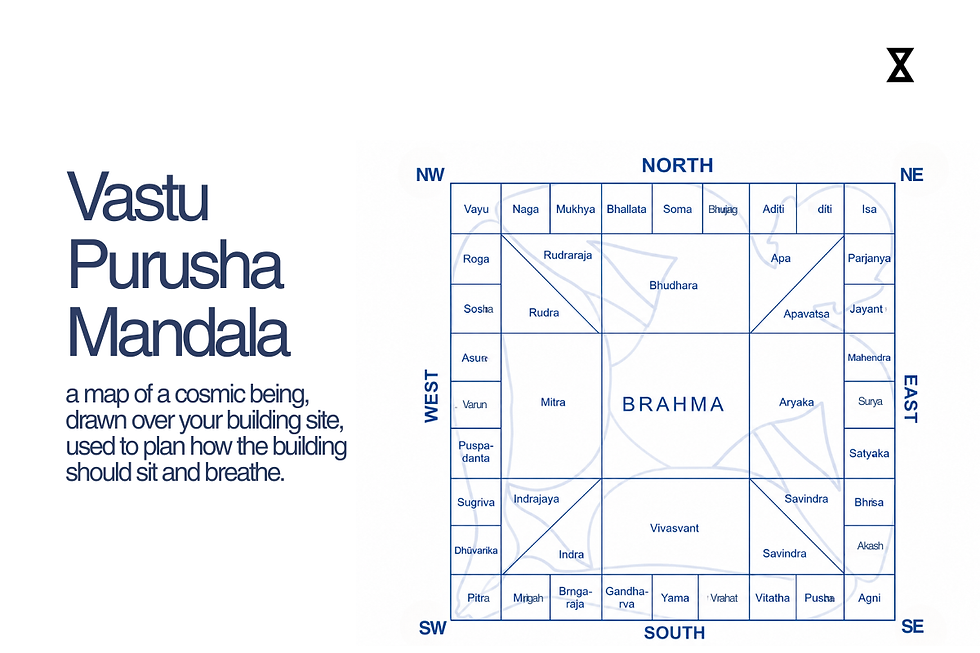
Older texts genuinely reference Hindu deities, and that's worth being upfront about. The Vastu Purusha Mandala, the grid system behind much of traditional Vastu, assigns each zone to a deity: What is Vastu Purusha covers this in depth, but in short, Kubera governs the north, Agni the southeast, Ishana (a form of Shiva) the northeast, and so on. That's a real connection to Hindu cosmology, not a metaphor. At the same time, those same zones hold up on purely functional grounds: the Agni (fire) zone lines up with where heat and cooking naturally belong, the Ishana (northeast) zone lines up with morning light and quieter use. Whether you engage with the deity layer or just the design logic is a personal choice.
"Influencer Vastu" oversimplifies everything. Lemons for "removing negativity," fear-based warnings like "your marriage will fail if your kitchen faces north," none of this is Vastu. It's marketing dressed up as mysticism.
Cultural labels blur together. In everyday conversation, "Hindu," "Hindi," and "Indian" often get used interchangeably, even though they mean three different things: a religion, a language, and a nationality. That confusion spills over into how people categorize Vastu too.
None of this makes Vastu a religion. Being associated with Hindu belief isn't the same as being one: Vastu has no required worship, no clergy, no doctrine about salvation, and no single governing text everyone has to follow. It's guidance, drawn partly from belief, that you can take or leave, layer by layer.
The Design Logic Behind the Rules, and Where It Stops
Some of Vastu's directional guidelines line up with real, testable design logic. Others don't, and are better described as inherited belief. Both are part of the tradition. Only one of them is science.
What holds up as design logic:
East-facing entrances and windows capture gentle morning sun while avoiding the harsher heat of west-facing afternoon light.
Kitchens placed in the southeast put the heat-generating zone of the home away from resting and living areas, a basic thermal-zoning principle.
Heavier construction in the southwest creates thermal mass that shades and cools adjoining spaces later in the day.
Open, lighter northeast zones allow for better morning light and cross-ventilation.
A peer-reviewed paper published in the International Journal of Engineering Research & Technology notes that Vastu Shastra's directional principles are built on observations of the sun's movement, the earth's magnetic field, and natural energy zones, the same variables modern passive design and climate-responsive architecture still account for today.
What's inherited belief, not a testable claim:
Judgments about which directions are "auspicious" or "inauspicious" for a specific room or activity.
The idea that a particular entrance can invite conflict, loss, or good fortune into a household.
Deity-based meanings attached to specific zones (covered in the section above).
This second category isn't provable, and it isn't disproven either. It's the same category as a lot of cultural beliefs: not measurable, but not meaningless to the people who hold it, and not a lie just because it can't be run through a lab. What it isn't, is engineering. Calling it that is where a lot of "Vastu is pure science" content overreaches, and it's exactly the overreach that makes people distrust the genuinely testable parts too.
Myths vs. Facts
These aren't the same as the belief layer above. That's inherited tradition. What follows is exaggeration that's crept in around Vastu, mostly through word of mouth and fear-
based marketing, until it gets treated as gospel too.
Myth: A south-facing home is automatically unlucky. Fact: South-facing homes are commonly viewed as less auspicious in popular Vastu belief, and north-facing homes as favourable, but no single direction decides a home's fate. Orientation is one input among many, alongside climate, plot shape, and how the interior is laid out. Even within Vastu, a south-facing home is considered fixable with the right layout choices, not a permanent sentence
Myth: A Vastu-non-compliant home is always hard to resell or sells at a loss. Fact: Resale value is driven mainly by location, condition, pricing, and market demand. Vastu compliance can matter to some buyers, but it's a minor preference, not the deciding factor.
Myth: Vastu rules apply identically everywhere in the world. Fact: Traditional Vastu guidelines were shaped by a specific climate and hemisphere. Apply them without adjusting for local sun path and seasons (say, in the Southern Hemisphere), and the logic can actually work against you.
Myth: A non-compliant home is doomed to bring bad outcomes. Fact: Plenty of people live full, successful lives in homes that don't tick every Vastu box. Layout is one factor in a comfortable home, not the deciding one.
Myth: Fixing a Vastu "defect" always needs expensive remedies. Fact: Most real corrections are simple: repainting, rearranging furniture, or shifting where something is stored. Crystals and pyramids aren't mandatory, and many Vedic Vastu experts do recommend them as remedies, but a pricier version isn't inherently more effective than a modest one.

What This Means for Your Home
Because Vastu comes apart into layers, testable design logic, inherited belief, and outright exaggeration, you get to decide how much of it to use. Someone who wants nothing to do with symbolism can still use the orientation and airflow guidance. Someone who values the traditional, belief-based layer can use that too. Neither approach is more "correct" than the other, and neither one makes you religious or unscientific.
Think of Vastu tips as a starting point for smarter design decisions: where to place a kitchen for better heat management, which direction to orient a main door for better light, how to zone a home for comfort. They're useful guidelines, not rigid rules, and definitely not religious obligations.
Where it gets specific to your plot, your city's climate, or your home's actual layout, a professional opinion is worth more than a generic checklist. That's exactly the kind of detail an Hourly.Design expert can walk you through, without any sales pressure, just a clearer read on what actually works for your space.
FAQs
Is Vastu a Hindu religious practice?
No. Vastu Shastra developed within an Indian cultural and Vedic context, and some of its symbolism genuinely draws on Hindu belief. But it has no required worship, clergy, or doctrine, which is what would actually make it a religious practice rather than a tradition that involves belief.
Can non-Hindus follow Vastu?
Yes. Anyone can apply Vastu's design principles, orientation, room placement, ventilation, regardless of their religion or beliefs. The testable parts don't require faith, and the symbolic parts are optional.
Is Vastu based on science or belief?
Both, honestly. Its directional and orientation guidance is grounded in observable things like sun path, airflow, and thermal comfort. Other parts, like which directions are considered auspicious, are inherited cultural belief that can't be measured. Neither part is fake, they're just different kinds of knowledge.
Do I need to follow every Vastu rule for a "good" home?
No. Vastu works best as a set of guidelines, not an all-or-nothing checklist. Prioritize the elements that genuinely affect comfort and function in your specific space, and take or leave the symbolic layer as it suits you.
Key Takeaways
If there's one line to remember from this why Vastu is not religion breakdown, it's this: it's a layered tradition, not a single, clean category, and none of its layers adds up to religion.
Vastu Shastra means "science of architecture," though the tradition is broader than that translation suggests.
Some of its rules (orientation, airflow, thermal zoning) are testable design logic. Others (auspiciousness, deity symbolism) are inherited belief, real but not measurable.
Confusion with religion comes from real cultural and historical overlap, not from Vastu having worship, clergy, or doctrine.
Anyone, regardless of faith, can use as much or as little of Vastu as they want.
For plot-specific or layout-specific guidance, a design expert gives more accurate answers than generic rules.
Conclusion
Vastu doesn't ask you to practice a religion. It asks you to think about how your home handles sunlight, airflow, and space, and if you want, some inherited symbolism too. You can take the design logic and leave the belief, take both, or take neither. None of those choices make Vastu more or less legitimate, and none of them make it a religion.
If you're weighing a home layout and want to know what actually holds up and what's just noise, it's worth talking to a design expert who can give you a straight, practical read on your specific space.


Comments