


North-East: The Brain of the House

In a lot of homes that follow Vastu, you'll notice the same quiet habit: the north-east corner is the one spot where nobody dumps anything. The pooja shelf lives there, the window stays clear, and the shoe rack and storage trunk end up somewhere else entirely. That habit comes from one idea. Vastu treats the north-east as the brain of the house, the corner tied to clarity, calm, and how a household starts its day.
Below is a practical vastu guide to that corner: how to locate it in your own floor plan, what belongs there, what doesn't, and what to do when your layout doesn't cooperate. If you'd like the grid behind it all first, our guide to the Vastu Purusha Mandala explains how Vastu assigns each direction its deity and purpose.
Good news before you start: most of this is about placement and upkeep, not construction.
First, Find Your Actual North-East Zone
You can't apply any of this without knowing where the north-east really is, and guessing gets people into trouble more often than you'd think.
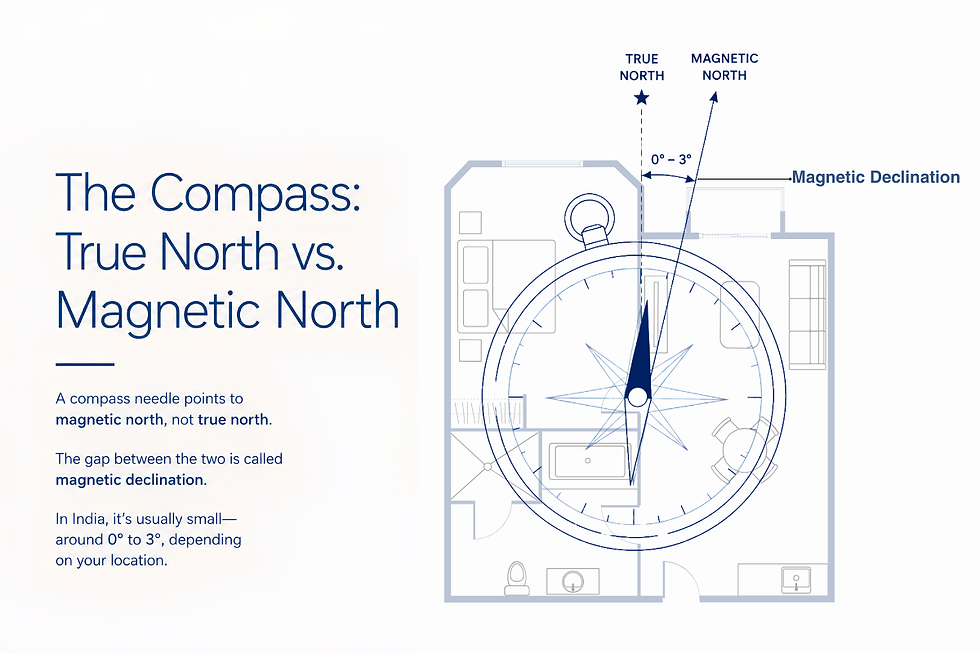
Stand at the center of your home or plot, not in a single room, and use a compass app or a physical compass to find north. Our compass guide walks through getting a reading you can trust, including the correction most people skip. Then divide your floor plan into a 3x3 grid. With north at the top, the top-right block of that grid is your north-east zone, known in Vastu as the Ishan Kon.
North-East Zone vs. North-East Facing House
These two get mixed up constantly, so it's worth separating them early.
A north-east facing house is about which way your main entrance opens, and it changes where rooms should ideally go. A north-east zone exists in every home, whichever way it faces. It's simply the north-east block of your layout, and the same core rules apply whether your front door opens north, south, east, or west. This blog is about that second question. For a sense of how a home's facing direction shapes room placement, our guide to north vs south facing houses is a good place to start.

Why the North-East Is the Brain of the House
Two things sit behind the name, and one short section covers both.
The traditional reason. The north-east belongs to Ishana, a form of Shiva and the guardian of this direction, and it sits where Kubera's north (wealth) meets Indra's east (knowledge). The north-east is the meeting point of both. In the Vastu Purusha Mandala it is also where the cosmic figure's head lies, which is the literal root of calling the north-east the brain of the house.
The practical reason. The north-east side of a home tends to be where morning light arrives first and softest. A study of office workers found that optimized daylight and views improved both sleep and cognitive performance, which fits the idea that a bright, calm corner is a good place to think, pray, or study.
North-East at a Glance
A quick reference for the associations Vastu assigns to this direction:
Aspect | Association |
Deity | Ishana, a form of Shiva |
Ruling planet | Jupiter (Guru), linked to wisdom and learning |
Element | Water |
Best colors | White, light blue, soft pastels. Avoid: red, black, dark brown |
Governs | Mental clarity, focus, prayer and meditation, learning, calm decision-making |
That's all the mythology you need. The rest of this guide is practical.
Which Rooms Belong in the North-East
If you have flexibility in your layout, these are the spaces Vastu recommends placing here:
Room | Why It Works |
Pooja room or meditation space | The classic choice. The corner's calm light and sacred association suit prayer and quiet |
Study or reading nook | Supports focus and learning, the areas Vastu ties to this zone |
Main entrance | Commonly recommended for plots that face north or east |
Living room or open sitting area | An open, bright space keeps the corner light, as long as it stays uncluttered |
Garden or open courtyard | Open ground and water features suit the corner's water element |
Which Rooms to Avoid in the North-East
Just as clearly, a few room types are considered poor fits here:
Room | Why It's Avoided |
Toilet or bathroom | The most commonly cited north-east defect, seen as working against the zone's purity and clarity |
Kitchen | The kitchen's fire element is seen as clashing with the zone's water element. The south-east is the preferred spot |
Staircase | Believed to add weight to a corner meant to stay light. South, west, or south-west are better |
Bedroom | This corner is meant for focus and activity, and the south-west is the traditional spot for the master bedroom |
Store room | Heavy, rarely used storage belongs in the south-west or west, not here |
What to Keep in the North-East
Not sure what actually goes in the corner? These are the safest additions:
A small water feature. A tabletop fountain, shallow bowl, or aquarium suits the zone's water element. Keep the water clean and clear.
A prayer corner or small altar. Even a compact shelf works if a full pooja room isn't possible.
Small, healthy plants. Tulsi is the traditional pick. Keep plants low and well cared for.
Light furniture and open shelves. A low reading chair or a light bookshelf works. Leave open floor space around it.
Clear windows and fresh air. Sheer curtains and unblocked windows let the morning light do its job.
What to Keep Out of the North-East
Heavy almirahs, safes, and bulky storage. Vastu treats a weighed-down north-east as a drag on the whole home. These belong in the south-west.
Shoe racks, dustbins, and brooms. Cleaning supplies and waste in the most sacred corner are a frequent complaint.
Heat-generating appliances and fire elements. Fridges, heavy electronics, and stoves clash with the zone's calm, water-linked nature.
Broken or unused items. Junk piling up here reads as blocked clarity, not just an eyesore.
Dark, heavy colors. They work against the soft light this corner naturally gets.
Best Colors and Lighting for the North-East
White, light blue, and soft pastel tones are the standard recommendations for north-east walls. They work with the corner's gentle morning light instead of against it. Avoid red, black, and dark brown, which add visual weight to a zone meant to feel open.
Keep the lighting simple: let natural light in first, and add soft, even artificial light for evenings. A corner that feels bright and airy at every hour is doing what Vastu wants.
Common Vastu Doshas in the North-East, and How to Fix Them
A "dosha" is simply a Vastu defect, a way the space works against its intended purpose. These are the ones that come up most:
Dosha | The Problem | The Fix |
Toilet or bathroom in the north-east | Considered to work against the zone's purity and clarity | Keep it spotless, well-ventilated, and light-colored, and add a small plant |
Kitchen in the north-east | Fire clashes with the zone's water element | Keep the stove in the south-east part of the kitchen and the corner itself light and open |
Heavy storage or machinery | Weighs down a corner meant to stay open | Shift bulky pieces to the south-west or west wall |
Cut or missing north-east corner | Seen as one of the more serious defects, common in irregular plots and flats | Keep what remains light and open, and get an expert read, since the right fix depends on how much is missing |
Clutter or dark colors | Treated as blocked clarity | Declutter regularly and repaint in white, light blue, or a soft pastel |

Design Elements That Work Well in the North-East
The north-east is the brain of the house, so the design goal is calm, light, and open. Here is how to make that work through placement, materials and layout, not just paint.
Keep the corner low, light and open. Vastu wants this zone to be the lightest and, ideally, the lowest part of the home. Keep the floor level with or slightly below the south-west, avoid a heavy false-ceiling drop or exposed beam over it, and place heavy furniture along the south-west and west walls. Choose pale stone, light wood or cane for anything that does sit here.
Plan the pooja unit with its direction in mind. A wall-hung or low plinth unit in white marble, light wood or solid surface suits the corner. Place it so the person praying faces east or north, though traditions vary. Leave a small gap between the idols and the wall, keep storage underneath shallow and only for pooja items, and never place it under a staircase or against a toilet wall.
Set up the study nook to face north or east. Position the desk so you face north or east, with a solid wall behind you and no beam overhead. Let daylight come from the side, and keep the desktop clear except for one lamp.
Place the water feature in line with the zone’s water element. A small recirculating fountain or shallow bowl in ceramic, stone, or glass suits the corner, set along the north or east side of the zone. Keep the flow gentle and the water clean, and avoid large tanks or any water feature in the south-east or south-west.
Open up the north and east walls. These are the sides where the zone’s morning light enters, so keep windows large and unblocked, and use sheer curtains. For evenings, warm white (2700 to 3000K) suits a pooja space and neutral white (3500 to 4000K) suits a study nook. The colour temperatures are a design call, not a Vastu rule.
Keep the palette and wall decor calm. Stay with white, light blue, and soft pastels, with pale yellow or brass in small touches, since both are linked with Jupiter. Limit wall art to one or two pieces of water, sky, landscape or spiritual themes, and leave plenty of blank wall. A small mirror is acceptable, but never facing the pooja.
Expert Insight: When a Vastu Consultant Actually Helps
Most north-east issues are fixable with the basics above. Where it genuinely helps to bring in a professional is when your layout is fixed, for example, a bathroom that can't move or a floor plan you can't restructure, and you need to know which fixes will realistically make a difference versus which are just for peace of mind. That's exactly where it's worth getting a second opinion, like booking a consultation with a Hourly.Design Vastu expert who can look at your specific floor plan rather than general rules.
FAQs
Does north-east Vastu apply the same way to apartments?
Yes. The direction doesn't change with building type. Apartments just offer less room to move walls or rooms, so color, furniture, and clutter fixes matter more than structural ones.
What if the north-east falls inside a bedroom or kitchen?
The corner of that room is still your north-east. Keep it clear and light, add a small plant or water element in a bedroom, and in a kitchen, keep the stove away from that corner.
Can I keep an aquarium or fountain in the north-east?
Yes, it's one of the most recommended additions. Keep it small, clean, and well maintained, and avoid large, heavy tanks that weigh the corner down.
What if my north-east gets little natural light because of a neighboring building?
Use pale colors, sheer curtains, and bright, even artificial lighting so the corner still feels open. The guidance here works with or without strong daylight.
Is it worth breaking a wall to move a bathroom out of the north-east?
It depends on the defect and how disruptive the work would be. For minor issues, decluttering, light colors, and a small plant usually go a long way. For a bathroom sitting squarely in the corner, weigh the cost of construction against a consultation first, since an expert can tell you which fixes will realistically help in your layout.
Key Takeaways
The north-east is the top-right block of your layout when north is at the top, and every home has one.
Good fits: pooja room, meditation space, study nook, open living area.
Avoid: toilet, kitchen, staircase, bedroom, and storeroom in this zone.
Keep: a small water feature, light furniture, small plants, and clear windows. Keep out: heavy storage, shoe racks, dustbins, and clutter.
Best colors: white, light blue, soft pastels. Avoid red, black, and dark brown.
Most issues are fixable without construction: declutter, repaint, reposition.
Conclusion
Treat your north-east as the brain of the house Vastu describes it to be, and the fixes needed are rarely dramatic. Know where it is, keep it open and well-lit, place the right rooms in it, and steer the wrong ones elsewhere. These practical vastu tips work whether your home was built with Vastu in mind or not.
If your layout makes that harder than it sounds, from a fixed bathroom to a locked-in floor plan, a professional read of your specific space usually saves more time than trial and error. You can browse Hourly.Design's Vastu experts whenever you're ready for that kind of second opinion.
Explore more: for the wealth-focused neighbor of this corner, see our guide to the North Zone: The Money Magnet (Kuber's Corner)

Comments