


Vastu for Flat Buyers: How to Check a Floor Plan Before You Pay the Token Amount

Vastu for flat buyers comes down to one practical question: which parts of this layout can you change after you buy, and which can’t you? In a flat, the main door, kitchen, toilets and overall shape are fixed once the walls and plumbing stacks are built. Furniture, bed positions and finishes are not.
That is why the best time for a Vastu check is before you pay the token amount, while you can still compare flats and ask questions. This guide walks you through a first-pass check in the order a Vastu consultant would follow: get the right plan, find true north, mark the fixed items, then weigh them against everything else that matters in a purchase.
If you would rather have a professional read the plan, you can browse Vastu experts on Hourly.Design.
Short answer: Start with the sanctioned floor plan and a reliable north. Then check five fixed items: the main entrance, kitchen, toilets, master bedroom and any missing corners. Treat the result as one input alongside location, price, legal title and the builder’s record, not as a verdict on the flat.

What Vastu Can and Can’t Tell You About a Flat
Vastu Shastra is a body of traditional Indian architectural texts. It organises a building around directions, a central open zone and a grid called the Vastu Purusha Mandala. Consultants interpret these texts differently, so two experts can give you slightly different readings of the same plan.
Some directional ideas overlap with ordinary design logic, such as where morning light enters or which side takes the afternoon sun. Others rest on tradition and belief. A Vastu review can tell you which features of a layout fit traditional guidance and which don’t. It is not legal, financial or structural advice.
For a deeper look at where Vastu meets science and where it stays a matter of belief, read our even-handed guide to Vastu: science or belief
Before You Pay the Token Amount: Get the Right Floor Plan
Brochure drawings are often simplified, and the north arrow on them can be approximate. The document you want is the sanctioned floor plan, the version approved by the competent authority.
There are good reasons to insist on it:
You are entitled to see it. Under Section 11(3)(a) of the RERA Act, the promoter must make the sanctioned plans and layout plans available to the allottee at the time of booking and allotment.
Registered projects publish them. Promoters submit the sanctioned and layout plans when registering a project, and they are shown on the state RERA website. Compare the plan you were given with the one on the portal.
Layouts can’t be changed freely. Under Section 14, a promoter cannot alter sanctioned plans without the consent of at least two-thirds of allottees, although minor changes are allowed. If the plan is revised later, check it again.
The token counts toward a legal cap. Section 13 bars a promoter from accepting more than 10% of the cost as an advance or application fee without first signing and registering an agreement for sale. Your token amount is part of that 10%.
You can read all of these provisions in the RERA Act on India Code. Before paying anything, ask the developer in writing whether the token is refundable and on what terms, since practice varies.
Step 1: Find True North on the Plan
Every Vastu reading depends on direction, so a wrong north makes the whole check wrong. Here are three ways to get it right:
Use the arrow on the sanctioned plan. If it is missing or looks doubtful, ask the architect or developer to confirm it in writing.
Check on site with a compass. Stand in an open spot away from steel railings, lift shafts and electrical panels. Steel and electrical equipment can distort a compass, and this is often a bigger source of error than anything else indoors. Take readings in more than one spot and compare them.
Cross-check on a map. Open a satellite view of the project and compare the tower’s position against the plan.
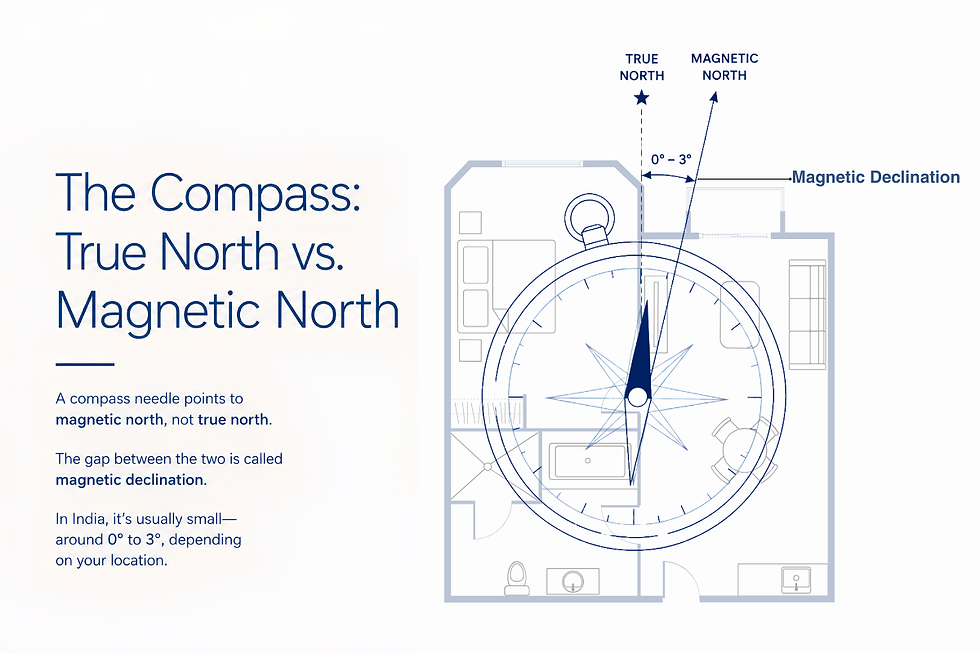
One technical point: a compass points to magnetic north, which is not the same as true north. The gap is called magnetic declination, and it changes with place and over time, according to NOAA’s magnetic declination resource. NOAA’s calculator gives the value for your location. In Indian cities the figure is generally small, but look up your own rather than assume.
Don’t judge direction by which way the balcony seems to face. Use true north on the plan. For a longer walkthrough, see our guide to checking directions in your house with a compass
Step 2: Lay a Vastu Grid Over Your Flat
Traditional Vastu mandalas are built on grids such as 8×8, 9×9 or 10×10 cells, according to the School of Planning and Architecture, Bhopal’s glossary of Vastu terms. In everyday practice, consultants often work with a simpler nine-zone version.
To use it, draw a 3×3 grid over the outline of your flat, aligned to true north. You get:
Four corners: north-east, south-east, south-west and north-west
Four sides: north, east, south and west
One centre, the Brahmasthana, traditionally kept open
Now you can label each room by the zone it falls in.
Step 3: Mark the Five Things You Can’t Change Later
In a flat, walls, plumbing stacks and shafts are fixed. These five items are the ones worth checking first. The directions below are the ones most commonly cited, and schools differ on the details.
What to check | Commonly preferred | Commonly avoided | Can you fix it later? |
Main entrance | North, east or north-east | South-west; some schools also caution south-east and north-west | No, the position is fixed |
Kitchen | South-east, with north-west as the second choice | North-east and south-west | Rarely, as plumbing, gas and exhaust are planned around it |
Toilets | West or north-west | North-east, centre of the flat, south-west | No, plumbing stacks are fixed |
Master bedroom | South-west | North-east | Partly, you choose which bedroom you use |
Shape and corners | A regular square or rectangle | Cut or missing corners, especially in the north-east | No |
Checking the main entrance
Buyers often fixate on the facing alone, but an entrance check has three parts:
The side of the flat the door sits on, using true north from Step 1.
Where along that wall it sits. Traditional texts divide each side into small segments called padas, and many consultants consider which segment the door falls in. Schools differ on which are favoured, so ask which convention your consultant follows.
What is right outside. In apartments, that could be a lift shaft, staircase landing or a neighbour’s door directly opposite.
Whichever way it faces, a well-lit, uncluttered entrance is a sensible choice.
Does the facing of the flat matter?
Facing matters less than the layout inside. An east-facing flat with a toilet in the north-east raises more Vastu questions than a west-facing flat with a south-east kitchen and a south-west master bedroom.
People also use “facing” loosely. Some mean the direction of the main door, others the balcony or the front of the building. Ask whoever reviews your plan which convention they use so that two opinions don’t contradict each other for no reason. For a wider look at one common worry, see our comparison of north and south facing houses
Step 4: Check the Rest of the Zones
After the fixed items, look at how the flat uses its zones. These are traditional preferences:
North-east: kept open, light and free of clutter, often used for a living area or prayer space. Many consultants treat a toilet or kitchen here as the most serious concern.
Centre: kept open, without a toilet or a heavy cluster of walls.
South-west: the master bedroom, heavy storage and furniture.
Balconies: traditionally preferred on the north or east side.
What You Can Adjust After Moving In
The longer list is the good news. These changes need no demolition:
Who sleeps where: choose the bedroom each person uses.
Bed direction: traditional guidance suggests the head towards south or east.
Heavy furniture: place it along the south and west walls.
The north-east corner: keep it light and decluttered.
Cooking position: many guides suggest the person cooking faces east.
Finishes: colours, lighting and décor.
Rearranging how you use rooms costs far less than structural change, so start there.
Should Vastu Decide Whether You Buy?
Vastu is one input, not the whole decision. Location, price, RERA registration, legal title, approvals, the builder’s track record, light, ventilation and resale value all matter too.
A useful way to use your findings is to sort them into three groups:
Acceptable as they are
Fixable inside the flat
Deal-breakers for you
The third group is personal. Two buyers with the same plan may draw the line in different places, and that is fine.
Want a Professional to Read the Plan?
A first-pass check like this covers the basics, but plans vary and schools differ. If you want an expert opinion on a flat you are considering, you can browse Vastu experts on Hourly.Design and pick the one who suits you. Share the sanctioned plan with north marked, so they can start from a reliable base.
Vastu for Flat Buyers: Checklist
☐ Sanctioned floor plan in hand, with a north arrow
☐ Plan compared with the one on the state RERA portal
☐ North confirmed on site and on a map
☐ 3×3 grid drawn over the flat
☐ Main entrance side and position noted
☐ Kitchen and toilet zones noted, especially the north-east
☐ Missing corners checked
☐ Master bedroom zone noted
☐ Fixable items listed separately from fixed ones
☐ Vastu weighed alongside location, price, title and builder record
☐ Token terms confirmed in writing
Key Takeaways
First step: get the sanctioned plan and a reliable north. A wrong arrow makes the whole check wrong.
Fixed items: the entrance, kitchen, toilets, master bedroom and corners can’t easily be changed later.
Facing: matters less than the layout inside.
Easy fixes: bed direction, furniture and décor can be adjusted after you move in.
Perspective: schools differ, so treat Vastu as one input among many.
FAQs
Which direction is best for the main entrance of a flat as per Vastu?
North, east and north-east are the directions most commonly named as preferred. South-west is the one most often cautioned against, and some guides also caution south-east and north-west. Guides differ on west and south, and the position of the door along the wall also matters, so treat this as a starting point rather than a final rule.
Which facing is best for a flat: east, north, west or south?
East and north are most often called preferred, while south and west are often called less favoured. Even so, many consultants say the layout inside matters more than the facing. A south-facing flat with a well-placed kitchen, toilets and master bedroom can read better than an east-facing flat with a toilet in the north-east.
Is a toilet in the north-east of a flat a deal-breaker?
It is the layout issue most guides treat as the most serious. In a flat the plumbing stack is fixed, so the toilet generally can’t be moved. Remedies such as salt bowls or pyramids are widely circulated, but we have not found evidence that they work, and they don’t change the layout. The practical question is whether you can accept this feature in the flat as built.
Can a toilet sit above or below the kitchen or pooja room in a flat?
Several guides advise against placing a toilet above or below a kitchen, pooja room or bed. Because flats are stacked, this depends on the neighbouring floors. Ask the developer for the layout of the floors above and below as well as your own.
Which floor is best as per Vastu for a flat?
Guides disagree. Some name the ground floor, others the first to third floors, and others tie the answer to the flat’s facing. With no single answer, it is worth weighing floor against light, ventilation, noise and price rather than on Vastu grounds alone.
Does the direction of the building’s entrance matter, or only my flat’s door?
Most guides focus on the flat’s own door and internal layout, and treat the building’s entrance as secondary. That means two flats in the same tower can read very differently.
Can I check a flat’s Vastu from a floor plan alone?
For layout items such as the entrance, kitchen, toilets, master bedroom and corners, a sanctioned plan with a reliable north is usually enough. Things the plan doesn’t show, such as what sits outside the door or beyond the balcony, need a site visit.
How much can a builder collect as a token before the agreement for sale?
Under Section 13 of the RERA Act, a promoter can’t accept more than 10% of the cost as an advance or application fee without first signing and registering an agreement for sale. Whether your token is refundable depends on the booking terms, so get them in writing before you pay.
What if the flat has a Vastu issue but I like everything else?
Sort the issue into fixed or fixable. Furniture, bed direction and room use can change after you move in. Entrance, toilets and corners can’t. If the issue is fixed and matters to you, get a second opinion before paying, because schools differ. If it doesn’t, weigh it alongside everything else.
Conclusion
Buying a flat involves a long list of decisions, and Vastu is only one of them. What makes it useful is timing. Checked before the token, it tells you which features you can live with and which you can’t, while you still have options.
Start with the sanctioned plan, get north right, mark the five fixed items, and keep the rest for after you move in. If you want a second pair of eyes, a short conversation with a Vastu expert before you commit can save you from a costly surprise. You can talk to an expert on Hourly.Design whenever you are ready.

Comments