


South West Vastu: Why This Corner Is Kept Heavy, and What Belongs There

South west vastu comes down to one idea: in traditional Vastu guidance, the south-west corner of a home should be its heaviest, most closed and most settled part. That is why it is the classic place for the master bedroom and heavy storage, and why an entrance, a toilet, an underground tank or an empty corner there worries people.
This guide goes past the list of dos and don'ts. It explains why the tradition treats this corner so carefully, adds the practical reason that sits beside it (afternoon heat, which is real), and walks through the remedies people actually apply for each south-west problem.
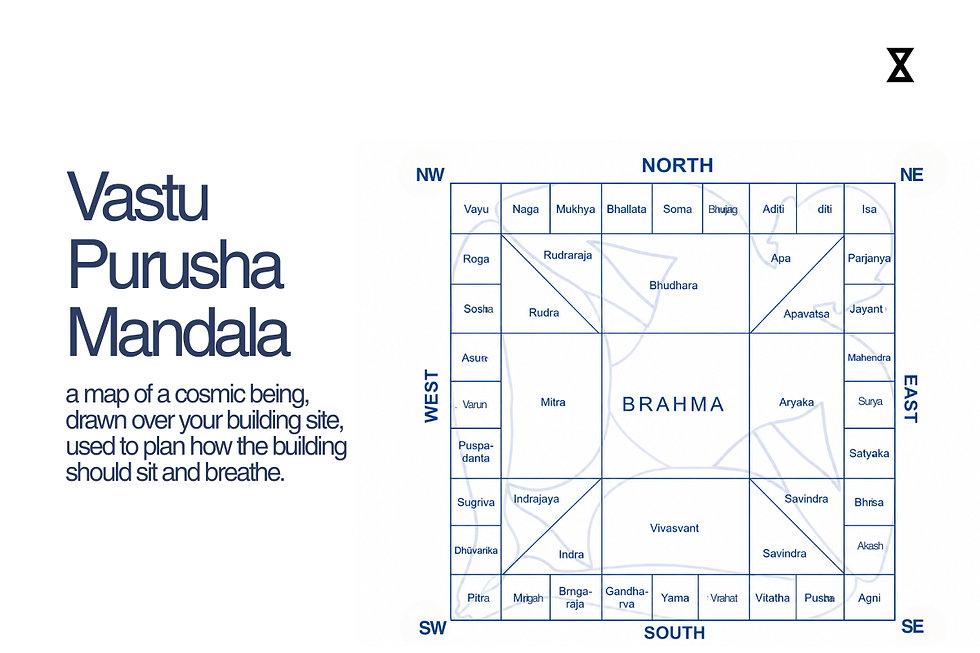
If you want the bigger picture first, our guide to the Vastu Purusha Mandala explains the grid that places the south-west where it is.
Short answer: South west vastu keeps the south-west corner heavy, closed and settled. Traditionally that means the master bedroom, wardrobes and heavy storage, and no entrance, toilet, underground tank or empty corner. Earthy colours suit it. If yours isn't ideal, start with non-structural fixes like heavy furniture and a closed door.
What does the south-west mean in Vastu?
In traditional Vastu guidance, the south-west is called Nairutya, and it is the zone of stability, weight and support. Hindu tradition gives each of the eight directions a guardian, and the south-west's guardian is Nirriti (also spelled Nirrti). Vastu as commonly taught links the zone with the earth element.
Here is the part most guides skip. Nirriti is commonly described as a figure of decay, misfortune and destruction. That gives the corner a cautious reputation, and traditional guidance answers it with weight, closure and steady use rather than leaving the zone open or empty. Teachers explain the link in different ways, so treat this as the tradition's reading.
Many Vastu consultants also describe the south-west as the zone of relationships and long-term stability in a family. That is a belief, not a promise of anything.

Why does south west vastu keep the corner heavy and closed?
There are five traditional layers behind the rule, and one plain practical reason. Teachers tell the story in different ways, but the layers all point to the same corner.
Layer | What the tradition says | What it means in your home |
The body of the plan | In the story behind the Vastu grid, the cosmic figure lies with his head in the north-east and his feet in the south-west | The north-east stays light and open, and the south-west is the grounded end that carries the weight |
The element | The south-west belongs to earth, the element of weight, ground and permanence | Solid, heavy and settled use, not openness or emptiness |
The guardian | Nirriti, commonly described as fierce, a force of dissolution. Teachers say her energy has to be settled with physical weight | Weight and closure in the zone, with no entrance or empty corner |
Ancestors and elders | Many teachers call the south-west the zone of ancestors (Pitru) and of the head of the household | The senior couple sleeps here, and some families keep ancestors' photos in the zone |
The planet (some schools) | Vedic astrology links the corner with Rahu, a shadow planet | A further reason for caution, and for treating the zone gently |
Put together, the plan has a light head and heavy feet. The north-east lets light and good energy in, and the south-west is the anchor that keeps it there. Some teachers describe a strong south-west as what holds whatever enters from the north-east inside the home. That is the tradition's reasoning, not a measured effect.
The practical reason. There is a plain weather reason too, and you may already know it. In India the afternoon sun comes in from the south and west, and a south-west corner room usually has outside walls on both sides. Think of how a west-facing room feels at four in the afternoon in May. Thick walls, few windows and heavy storage on that side keep the heat out, which is just what the traditional advice asks for. India's residential energy code agrees on the pattern: when it calculates how much heat a wall lets in, it counts south-west walls among the sunniest of the eight directions, as you can see in the Eco-Niwas Samhita 2018.
The heat explains part of the rule, not all of it. The code says nothing about Vastu, and the tradition's reasons go well beyond sunlight. But on this side of the house, heavy, closed and shaded is also the cooler way to build.
How do you find the south-west of your home?
The quick method: stand at the centre of your home with a compass, find north, and the south-west is the corner diagonally opposite the north-east. For a proper reading, follow these four steps.
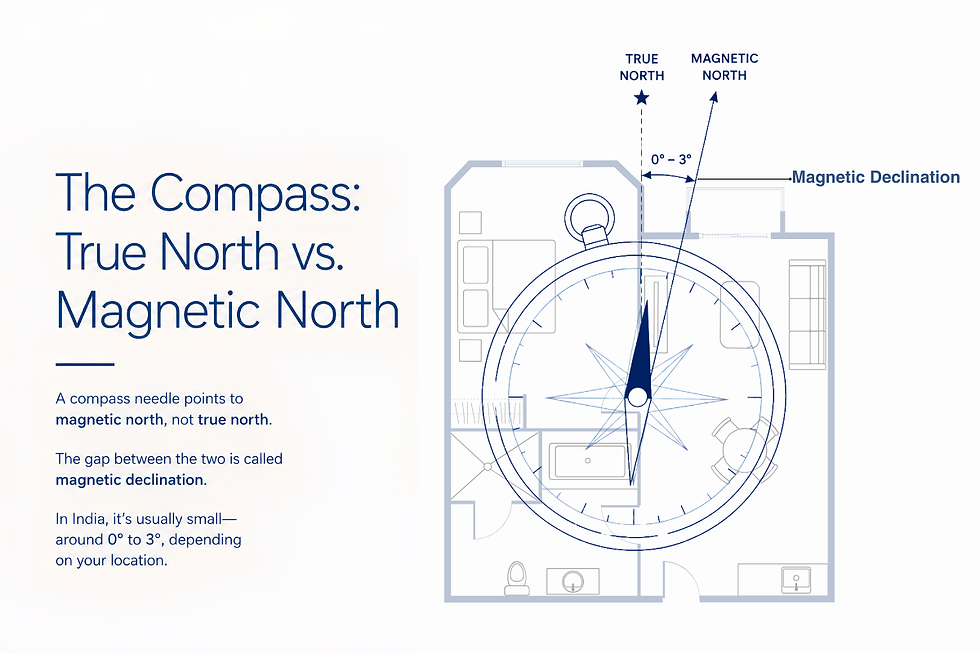
Step 1: Get a reliable north. Use a compass or a compass app. Stand near the centre of the home, hold the phone flat, and keep it well away from the fridge, steel almirahs, TVs and speakers, which pull the needle off. Take readings in two or three spots and check that they agree. A compass shows magnetic north, which differs slightly from true north. In Indian cities that gap is usually small, and stray metal and electronics are the bigger source of error.
Step 2: Find 225 degrees. On a compass, north is 0 degrees and angles run clockwise, so south-west is 225 degrees. On the usual eight-zone chart, the south-west zone is the 45-degree slice from 202.5 to 247.5 degrees. Some consultants use sixteen zones instead, which makes each slice narrower, so ask which chart yours uses.
Step 3: Check the plan's north arrow. A brochure plan's arrow can be wrong, or the plan may be rotated to fit the page. Compare the arrow with your compass reading on site. Our guide on how to check directions in your house goes deeper on true and magnetic north, and how to read house construction plans shows how to find the arrow and the scale on a plan.
Step 4: Mark the south-west on the plan. Turn the plan until its north arrow points straight up. For a rough version, divide the plan into a 3x3 grid, and the south-west is the bottom-left box. For a precise version, mark the centre of the plan, then use a protractor to draw lines from the centre at 202.5 and 247.5 degrees, measured clockwise from north. Rooms inside that slice are in the south-west. The centre of a rectangular plan is where its two diagonals cross.
Separate the house from the room. Vastu looks at both. The south-west of the house decides what the room there is used for. The south-west corner of an individual room decides where heavy furniture goes inside it.
Be careful with irregular plans. An L-shaped flat or a plan with a large balcony has no obvious centre, and consultants may treat balconies and cuts differently. If your plan is irregular, have the zones marked by someone who does it regularly.
What should go in the south-west as per Vastu?
Heavy, settled and private things. Traditional guidance usually puts these in the south-west:
Room or item | Why it is placed here (traditional guidance) |
Master bedroom | For the head of the family, in the zone linked with stability |
Wardrobes, almirahs and heavy furniture | Weight belongs here, along the south or west walls |
Storage room | Keeps the zone full and closed |
Locker or safe | Commonly suggested here, opening towards the north |
Staircase or overhead water tank (independent houses) | Adds height and weight on the south and west side |
Inside any room the same logic applies in miniature: heavier furniture towards the south-west corner of the room, and the north-east corner of the room kept lighter.
Which way to point your head in a south-west bedroom is a place where sources disagree. Some say south, others say south or east and rule out north. If it matters to you, settle it with a consultant who has seen your room.
What should you avoid in the south-west?
Openness, lightness and anything that drains the zone. These are the placements traditional guidance flags most often.
A main entrance. This is the placement people ask about most. The worry is that it opens the heavy zone straight to the outside. Sources do not agree: some advise avoiding it altogether, others say it is not necessarily a problem, and one says an entrance late in the south-west quadrant can be corrected if the rest of the layout follows Vastu.
A toilet or septic tank in the corner. A toilet is a place of disposal, and the tradition wants this zone to hold and settle. Some schools allow a toilet in the south-south-west, so the exact position matters.
A kitchen. Fire is linked with the south-east, and in the earth zone the tradition sees a clash between the two.
Underground water tanks, borewells, pits or basements. Depth hollows out a zone that is meant to be solid. Sources are not unanimous here, and at least one lists a borewell in the south-west as acceptable, so check before acting on a single source.
A cut or missing corner in an irregular plot or flat. The grounded corner of the plan is simply absent.
Large windows, balconies or an empty, unused corner. Openness and emptiness are the opposite of a heavy, settled zone, and the sun makes the same point.
A south-west lower than the north-east, in a plot or house with levels. The feet end of the plan is meant to be the high, heavy end.
Some of these can't be changed in a flat. That is normal, and the remedies below show what people usually do about each one.
What is south-west Vastu dosh, and how serious is it?
Dosh (dosha) means a flaw. South-west Vastu dosh is the term people use when the south-west zone has one of the problems above: an entrance, a toilet, a kitchen, a cut, an underground tank or an empty corner.
It helps to know how Vastu itself treats this. Most schools do not say these problems are permanent. They prescribe remedies, mostly changes to placement and use, and many are applied in real homes without any construction. None has been measured in a study, so treat them as the tradition's practice and not as guaranteed fixes. A dosh is a reason to look closer. It is not a reason to panic, and it is not a reason by itself to back out of a flat you otherwise like.
Structural problems are costly to change once you sign, so check the south-west on the plan before you pay the token amount. Our guide to checking a flat's floor plan before you pay covers what to ask for. Under Section 11(3)(a) of the RERA Act, the promoter must make the sanctioned and layout plans available to you at the time of booking, and you can read it in the RERA Act on India Code.
South west vastu remedies that don't involve breaking walls
South west vastu remedies rest on two ideas: add the weight the zone is meant to have, and reduce what opens it up. A few moves appear in almost every case, and then each problem has its own set.
The moves used for almost every south-west problem
Weight. Heavy furniture, stone or terracotta pieces and large planters with soil, kept on the south and west side.
Colour and light. Yellow, golden and other earthy shades, with warm light, to strengthen the earth element.
Use. Keep the corner occupied and uncluttered, never empty or dusty.
Closure. Doors kept shut and heavier curtains on large windows.
Observance. Some families add ancestor-related rituals, such as Pitra Paksha observances, because the zone is linked with ancestors.
Main door in the south-west
Commonly done: keep the door solid and heavy and keep it closed. Place heavy furniture or a stone piece just inside. Some families set a brass strip or wire in the threshold, or mark the door with auspicious symbols such as the swastika or Om. Some also arrange the inside so that the path leads towards the north or east, not straight into the south-west.
The idea: the tradition does not want the heavy zone opened to the outside, so the remedies add weight at the opening and redirect the way people move inside.
Where sources differ: door colour. One source suggests deep earthy shades such as brown or maroon and warns against red, white and yellow. Another recommends yellow, golden and off-white for the zone. If your whole house faces south-west, our guide to a north vs south facing house covers how facing is read.
Toilet in the south-west
Commonly done: keep the door closed, fit an exhaust fan (some sources say on the north-east or east wall), keep the toilet dry and fix leaks quickly, and use light earthy colours such as beige or yellow. Some people also keep sea salt in a bowl and change it weekly. In new work, the toilet door goes on the north or east wall.
The idea: a toilet is a place of disposal, and the tradition does not want that in the zone meant to hold and settle. So the remedies keep it contained, clean and dry.
Honest note: ventilation and dryness are real hygiene benefits in any bathroom. There is no evidence behind the salt, and pyramids or lead items sold for this are optional extras of the same kind.
Cut or missing corner
Commonly done: put heavy furniture or a stone or terracotta sculpture beside the cut, add a big planter with soil, use yellow or golden colour with warm yellow lighting, and hang square-shaped pictures or pictures of mountains to bring in the earth element. Keep the most weight on the south and west walls.
The idea: the corner is missing, so the remedy adds earth element to make the zone feel complete.
Where sources differ: mirrors. Some suggest a mirror on the adjacent wall to extend the corner, while others say avoid mirrors on the south-west wall. If you are unsure, start with the weight and colour moves.
Kitchen in the south-west
Commonly done: move the stove to the south-east part of the kitchen and cook facing east. Keep the sink and water away from the south-west side, and keep heavy storage such as grains and the fridge on the south or west walls. Some families also run a small second cooking spot in the south-east of the home.
The idea: fire in the earth zone is seen as a clash, so the stove goes to the fire corner of the room.
Where sources differ: colour. Some advise light or earthy shades and avoiding dark and red tones, while one suggests vibrant ones.
How to judge remedy advice
Start with the free moves: weight, use, colour, closed doors and ventilation. Many online lists also push sold items such as lead, brass or copper strips, pyramids and crystals. They are widely sold, no study shows they work, and lead is toxic, so if you ever use a lead item, keep it sealed and away from children. Be wary of anyone who asks for structural change or a large payment first, or who promises results. For a toilet, entrance or cut you can't change, ask a consultant for remedies that suit your actual plan.
Is a south-west bedroom too hot, and what helps?
It can be, on summer afternoons, because south and west walls take a lot of afternoon sun. That is a comfort question, not a Vastu one, but it matters if you follow the tradition and put the master bedroom here.
Shade that sits outside the window stops the sun before it heats the glass, and India's residential energy code counts only that kind of shade: overhangs, side fins, balconies, verandahs and fixed canopies. In its own calculation, a deep fixed overhang over a south-west window cuts the heat from the sun through that window by roughly half. That is a calculation used to check designs, not a promise for your room, but it shows how much a chhajja is worth.
Keep south-west windows few and shaded. Fewer openings fit the tradition and the heat logic. Fewer does not mean none, because the room still needs air.
Shade outside first. A chhajja, louvres or a deep balcony do more than curtains. Curtains help with glare and comfort and are the second line.
Put storage against the hottest wall. Wardrobes along the south or west wall suit the tradition and keep the bed away from the warmest surface.
If you are building, ask your designer to check the south and west walls and windows for shading while the drawings can still change.
South west vastu colour: which shades suit the zone?
South west vastu colour advice leans towards earthy, warm and solid tones, because the zone is linked with the earth element. Beige, cream, sand, light brown, ochre and muted yellow are the usual suggestions.
Sources differ at the edges. One lists brown or black as suitable, while another advises against black, blue and red in this zone. If you want to stay on safe ground, keep to the light and mid earthy range.
You don't need to repaint the whole room. An accent wall in a warm neutral, wooden furniture and earthy fabrics do the same job, and they make a calm bedroom as well.
South west vastu tips for flats vs independent houses
In a flat you can't move the entrance or the toilet, so the tips are about use, furniture and colour. In an independent house or a plot you also control heights, levels, tanks and the staircase.
Flat | Independent house or plot |
Use the south-west room as the master bedroom | Plan the master bedroom in the south-west at the design stage |
Wardrobes and heavy furniture on south and west walls | Keep the south-west higher than the north-east |
Keep the south-west corner full and closed | Put the staircase and overhead tank on the south or west side |
Earthy colours and heavy curtains | No borewell, sump or septic tank in the south-west |
Check the plan before you buy | Avoid a cut south-west corner in the plot shape |
When is it worth talking to a Vastu consultant?
When the south-west has an entrance, a toilet or a cut you can't change, or when you are about to buy or build. Those are the cases where generic tips stop being enough and someone needs to look at your actual plan. For heat in a south-west bedroom, an architect or interior designer is the right person to ask.
You can browse experts on Hourly.Design and pick the one who suits your question. Share the sanctioned plan with the north arrow visible and, if you can, a compass reading taken inside the home.
FAQs
Is a kitchen in the south-west really that bad, and what can you do?
Traditional guidance treats it as one of the more serious placements, because it sees fire in the earth zone as a clash. The usual fix needs no demolition. Move the stove to the south-east part of the kitchen and cook facing east, keep the sink and water away from the south-west side, and store heavy items on the south or west walls. Sources differ on colour, with most advising earthy or light shades.
Who should sleep in the south-west bedroom: parents, children or guests?
Traditional guidance gives the south-west to the head of the household, because the zone is tied to stability and authority. That is why it is called the master bedroom. Sources differ on the others: some place children's rooms in the west or north-west, and guest rooms in the north-west. If the parents' room can't be in the south-west, a study or heavy storage room keeps the zone in steady use.
Why should the south-west be higher than the north-east?
The tradition pictures the plan as a body with its head in the north-east and its feet in the south-west. The head end is kept light and open, and the feet end heavy and high, so the plan stands on solid ground. In a plot that usually means the south-west sits higher than the north-east. In a flat you can't change levels, so you add weight in the south-west room instead.
Is an extended south-west corner good or bad?
Sources treat a south-west extension as too much of the heavy zone, which tips the plan out of balance. Typical advice is to avoid doors or mirrors in the extended part and to cut it off visually with a partition or colour. How much extension counts as a problem varies by school, so have the outline of your plan measured by a consultant.
Can ancestors' photos or a pooja room go in the south-west?
The south-west is linked with ancestors, so some sources suggest ancestors' photos on a south-west or south wall. For a pooja room, traditional guidance prefers the north-east, the zone linked with prayer, so the south-west is not the first choice.
How do you fix south-west Vastu in a rented flat?
You can't change the layout, so work on use, weight and colour. Put the wardrobe and storage in the south-west, use earthy curtains, bedsheets and rugs instead of repainting, keep a south-west toilet door closed and the room ventilated, and keep the corner occupied. If the south-west has an entrance, a toilet or a cut, check it on the plan before you sign the lease, because that is easier than correcting it afterwards.
Can you keep a mirror in the south-west?
Sources disagree. Mirrors are used in Vastu to extend or lighten a zone, which runs against the south-west's job of being heavy and settled, so many consultants advise avoiding a mirror on the south-west wall. Some sources do suggest a mirror on an adjacent wall to extend a cut corner. Either way, avoid a mirror that faces the bed.
Key Takeaways
The idea: traditional guidance keeps the south-west heavy, closed and settled.
Why: the plan's feet, the earth element, the guardian Nirriti and the ancestors all point to the same corner.
What goes there: the master bedroom, wardrobes and heavy storage.
The usual worries: entrances, toilets, kitchens, underground tanks, cuts and empty corners.
Remedies: weight, use, colour and closed doors come first. Sold items are optional.
Heat: a south-west bedroom needs external shade and fewer openings.
Timing: check the south-west on the plan before the token amount.
Conclusion
A corner that Vastu treats with this much care deserves a calm approach. The tradition asks for weight, closure and steady use. The afternoon sun asks for shade and fewer openings on the same side. Most homes can honour both without breaking a single wall, and that is the real strength of south west vastu: it is mostly about how you use the room.
If you are weighing a flat or planning a build and want someone to read your plan with you, you can talk to an expert on Hourly.Design whenever you are ready
Comments