


Toilet Vastu: Which Direction Works, and What to Do About a North-East Toilet

Where should a toilet be placed as per Vastu? Is a north-east toilet really a problem? And what can you do if your bathroom is already in the wrong direction?
Toilet vastu generally prefers the north-west, west or south-south-west and advises avoiding the north-east and centre of the home. But not every Vastu school agrees, particularly when it comes to the south, north and east.
This guide explains the preferred directions, toilet seat placement, bathroom colours, fittings, drainage and practical remedies. If you want to understand how these zones are divided, our guide to the Vastu Purusha Mandala explains the grid behind them.
Short answer: North-west, west and south-south-west are commonly preferred for toilets. The north-east and centre are generally avoided. If your toilet is already in the north-east, start with proper ventilation, dryness and maintenance before considering expensive structural changes.
1. Which is the best direction for a toilet as per Vastu?
The north-west, west and south-south-west are the most commonly recommended toilet directions in contemporary Vastu practice.
However, different Vastu schools use different directional divisions. Some follow eight directions, while others use sixteen narrower zones. This explains why one consultant may approve a position that another recommends avoiding.
Direction | General Vastu recommendation |
North-west | Commonly preferred; often the first recommendation |
West | Generally considered suitable |
South-south-west | Preferred in some sixteen-zone systems |
North-east and centre | Strongly discouraged in most systems |
South-west corner | Generally avoided; north, east and south are disputed |

Why are some directions preferred?
North-west: Traditionally associated with Vayu, the element of air and movement. Contemporary Vastu practice commonly considers it suitable for toilets.
West: Associated with Varuna and water. There is also a practical architectural argument for placing service spaces on warmer western sides, where they can help separate frequently occupied rooms from afternoon heat.
South-south-west: Considered a disposal zone in some sixteen-direction systems. It is important not to confuse this narrow zone with the entire south-west corner, which many traditions discourage for toilets.
Why is a north-east toilet considered a Vastu defect?
Traditionally, the north-east is associated with Ishana, prayer, clarity and the head of the Vastu Purusha. A toilet is considered an unsuitable use for this zone.
The centre, or Brahmasthana, is also traditionally protected from impurities. The Brihat Samhita, an early text discussing house planning, places the gods' room in the north-east and warns against defiling Brahma's central portion. Its house-building chapter does not prescribe a modern indoor toilet location.
There is a practical consideration too. North-east-facing walls generally receive less solar heat than west and south-west-facing walls in northern India. The Eco-Niwas Samhita gives orientation factors of 0.829 for the north-east, 1.143 for the west and 1.202 for the south-west at latitudes of 23.5°N and above. This can make the north-east useful for spaces occupied for longer periods, depending on the home's design.
These figures describe solar exposure, not evidence that a north-east toilet causes harm. See the Eco-Niwas Samhita 2018.
For more about this zone, read our guide to the north-east of a house.
2. How to check your toilet's direction
To find the direction of your toilet, measure its position relative to the centre of your home, not simply the direction in which its door opens.
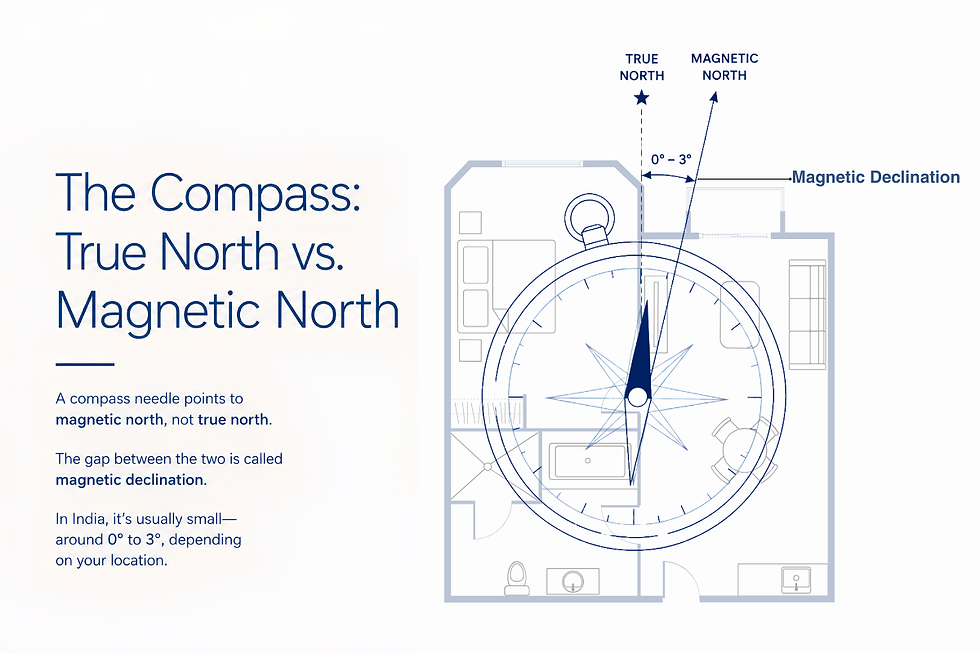
Step 1: Find north. Use a compass or compass app. Keep your phone away from large metal objects, appliances and electrical equipment, and compare readings from more than one spot.
Step 2: Locate the centre of your home. For a rectangular floor plan, draw two diagonals. Their intersection marks the centre. Irregular or L-shaped plans need more careful assessment.
Step 3: Locate the toilet. From the centre, identify the direction towards the middle of the toilet.
Step 4: Check the floor plan. Align the plan's north arrow with your verified compass direction. On a basic eight-direction layout, north-east covers approximately 22.5° to 67.5°, while north-west covers 292.5° to 337.5°. South-south-west occupies approximately 191.25° to 213.75° in a sixteen-zone system.
If your toilet falls between two zones, note both rather than forcing it into one.
For a more detailed walkthrough, see how to check directions in your house.
3. Which direction should the toilet seat face?
The most commonly recommended toilet seat direction is north or south, meaning you face either direction while seated.
Many contemporary Vastu sources advise avoiding east or west-facing seats. However, this guidance is not universal, and the commonly cited north-south rule is not clearly established in the classical text reviewed for this article.
In an existing apartment, changing the toilet seat direction may mean moving the waste outlet and modifying plumbing.
Before considering it:
Check the actual direction you face while seated, not the direction of the bathroom door.
Take compass readings away from metal fittings and pipes.
Confirm whether the outlet can be relocated without affecting waterproofing or the flat below.
Practical advice: If your bathroom works well and you're not renovating, changing the commode's direction should be a low priority.
4. Bathroom colours, flooring and drainage as per Vastu
Bathroom Vastu involves more than the direction of the toilet. Colours, floor finishes and water drainage are also common considerations.
Which bathroom colours are considered suitable?
Light shades such as white, cream, ivory, light grey and pale blue are widely recommended.
For a north-east bathroom, white and very light blue are common suggestions. West and north-west bathrooms are often associated with white, cream or light grey.
Sources disagree on certain colours, including yellow. There is no established evidence that a bathroom colour can correct an unfavourable Vastu direction.
From a design perspective, lighter finishes can make a compact bathroom feel brighter, especially with good lighting.
What flooring works best?
Traditional guidance often favours lighter, uncluttered bathroom finishes. More importantly, the flooring should be safe and easy to maintain.
Choose moisture-resistant, slip-resistant tiles, avoid surfaces that become dangerously slippery when wet, and ensure that the waterproofing beneath the finish is properly detailed.
A bathroom should not have stagnant water, regardless of its Vastu zone.
Which direction should bathroom water drain?
Many Vastu guides recommend a floor slope towards the north or north-east, following the traditional association of these directions with water.
But the actual slope must lead water safely towards the installed drain.
Changing the slope purely for Vastu may require breaking tiles and waterproofing. Proper drainage, waterproofing and avoiding water accumulation take priority over a preferred compass direction.

5. Where should the shower, geyser and mirror go?
Most Vastu recommendations for bathroom fittings follow the traditional association of water with the north and east, and fire with the south-east.
Here is a quick guide.
Bathroom element | Common Vastu recommendation |
Shower and taps | North or east side |
Geyser | South-east portion |
Mirror | North or east wall |
Washbasin | North or east side |
Bathroom storage | West or south side in some systems |
These recommendations are traditional guidelines, not fixed architectural requirements.
Shower and taps: Their position should also work with the plumbing and shower enclosure so water doesn't spread into the dry area.
Geyser: Although the south-east is commonly recommended, electrical safety, proper mounting, clearances and safe access are more important.
Mirror: Some Vastu sources advise against a mirror directly reflecting the commode. Others recommend mirrors as remedies, so the guidance is inconsistent. Practically, a mirror should be well lit, securely installed and protected from excessive moisture.
In a finished apartment, moving major fittings to match these recommendations is usually unnecessary unless you're already renovating.
6. Few Vastu tips to enhance bathroom and toilet interiors
You don't need a complete bathroom makeover to make the space feel cleaner, brighter and more comfortable.
Here are five useful improvements that work in most bathrooms.
1. Improve lighting. Use bright, comfortable lighting around the mirror and vanity. If the bathroom has a window, avoid blocking it with cabinets or heavy coverings. Traditional Vastu also favours light and openness.
2. Keep the bathroom clutter-free. Avoid overcrowding the vanity with bottles, cleaning products and unused accessories. Closed storage can help, particularly in smaller bathrooms.
3. Separate wet and dry areas. A glass partition or well-positioned shower screen can prevent water from spreading across the floor. This also makes everyday cleaning easier.
4. Choose simple, moisture-resistant materials. Light-coloured tiles, easy-clean surfaces and properly protected cabinetry make maintenance easier. Avoid materials that deteriorate quickly in humid conditions.
5. Make ventilation part of the design. An effective exhaust fan, clean ventilation openings and a well-maintained door help manage moisture and odours. Fix leaks and remove dampness rather than masking them with fragrances.
These changes don't promise to correct a Vastu defect. They improve the bathroom's actual usability while supporting the cleanliness and order encouraged in many Vastu recommendations.
7. What to do if your toilet is in the north-east
A north-east toilet vastu remedy is one of the most frequently searched concerns, especially for apartment owners who cannot change their plumbing.
The first thing to understand is that a north-east toilet is considered unfavourable in traditional Vastu, but there is no reliable scientific evidence that its direction alone causes illness, financial loss or misfortune.
If moving the toilet isn't possible, consider remedies in this order.
Level 1: Start with ventilation and hygiene
These improvements have clear, practical benefits:
Keep the floor dry and repair leaking taps or pipes.
Run the exhaust fan and ensure it works effectively.
Clean the room regularly and address mould or persistent dampness.
Keep the bathroom door closed when not in use, especially if it opens towards a bedroom or pooja area.
Ventilation is also a building-design requirement, not simply a Vastu preference. Delhi's Unified Building Bye-Laws include provisions for bathroom and toilet ventilation, including mechanical ventilation in specified situations. Requirements vary by location, so check the building regulations applicable to your home. See the Unified Building Bye-Laws for Delhi 2016.
Level 2: Use simple interior changes
Common Vastu suggestions for a north-east toilet include white or pale blue finishes, minimal storage and a bright, uncluttered surrounding area.
These changes are relatively inexpensive and do not require shifting pipes or breaking walls.
However, colours and rearranged accessories should not be presented as proven ways to neutralise a Vastu defect.
Level 3: Consider traditional remedies cautiously
Some consultants recommend sea-salt bowls, pyramids, mirrors on the outer bathroom door or blue lighting.
These are traditional or contemporary belief-based remedies, and sources disagree about their placement.
There is no reliable scientific evidence that salt bowls, pyramids or coloured lights correct the effects attributed to a north-east toilet. If you choose to use them, treat them as optional practices, not substitutes for ventilation, waterproofing or proper maintenance.
Avoid expensive remedy kits that promise guaranteed outcomes.
Level 4: Change the use or relocate the toilet
If you're planning a renovation, you may consider converting the space to a dry use or relocating the toilet, provided the new layout meets plumbing, ventilation and building requirements.
In apartments, relocation may be restricted by shared drainage stacks and waterproofing details.
A north-east toilet alone is rarely a sufficient reason for major demolition. Assess the practical consequences before making structural or plumbing changes.
8. Toilet Vastu for attached bathrooms and nearby rooms
Attached bathrooms are normal in modern homes, but Vastu recommendations also consider what lies beside, above or below a toilet.
Toilet next to the kitchen
Traditional guidance generally discourages placing a toilet directly beside a kitchen or sharing a wall with the cooking area.
Some building regulations also restrict toilets opening directly into kitchens.
If the rooms are already adjacent, focus on effective separation, ventilation, leak prevention and keeping plumbing in good condition. Relocating the kitchen hob is not automatically necessary.
Toilet next to the pooja room
Most Vastu sources discourage a toilet sharing a wall with the pooja unit or opening directly towards the prayer space.
If the layout cannot change, you may be able to move the pooja unit to a different wall, without modifying the toilet itself.
Attached bathroom in a bedroom
An attached bathroom is not automatically a Vastu defect. Its position within the home's directional layout still matters to consultants.
Common recommendations include avoiding a commode directly against the wall behind the bed and keeping the bathroom door closed when not in use.
Toilet under a staircase
Toilets under staircases are generally discouraged in Vastu.
The practical concerns can be more immediate: limited headroom, difficult ventilation and cramped access. If you're planning one, have an architect check whether it meets the applicable building requirements.
9. Can you move or convert a wrongly placed toilet?
Yes, but whether you should depends on the type of home, existing drainage, waterproofing and renovation costs.
In an independent house, there may be more flexibility to shift the toilet to another location, provided drainage and ventilation can be redesigned properly.
In an apartment, toilets are commonly connected to shared plumbing stacks. Moving a commode or changing the bathroom footprint can affect waterproofing, the structural slab and sometimes the apartment below.
In older buildings, removing existing tiles may expose hidden leaks or damaged waterproofing. Budget for repairing the underlying problem, not just installing new finishes.
During new construction, reviewing the toilet location before plumbing lines and slabs are finalised is generally the simplest option.
Before making changes, confirm society permissions, local building regulations and whether structural elements are affected. A qualified structural engineer should review any proposal involving slabs, beams or load-bearing elements.
Should toilet Vastu decide whether you buy a flat?
No. Toilet direction should be one consideration, not the deciding factor.
A flat's layout, ventilation, natural light, legal approvals, construction quality, location and affordability all matter.
If Vastu is important to you, check the toilet's position before purchasing, especially when comparing similar apartments. But don't reject an otherwise suitable home solely because of one bathroom without understanding the full plan.
Our guide to checking a flat's floor plan before buying explains what else deserves attention.
FAQs
Can a toilet be in the south-east direction?
The south-east is traditionally associated with Agni, or fire, so many Vastu sources discourage toilets there. Some systems make exceptions for narrower directional zones. If the toilet already exists, prioritise ventilation and maintenance rather than immediately planning relocation.
Is a toilet in the north direction good as per Vastu?
Most contemporary Vastu guidance discourages toilets in the north, traditionally associated with Kubera and wealth. However, recommendations vary between schools. Check the precise location before deciding that the entire northern side is unsuitable.
Can a toilet be in the south-west corner?
Most Vastu sources discourage toilets in the main south-west corner. This should not be confused with south-south-west, which some sixteen-zone systems consider suitable for disposal functions. The exact zone matters.
Should the bathroom door always remain closed?
Keeping it closed when the bathroom is not being used is a common Vastu recommendation and can help separate the bathroom from nearby rooms. However, the door must not prevent necessary ventilation. Ensure that the exhaust or ventilation system works effectively.
Can Vastu remedies work in a rented apartment?
You can make reversible changes such as improving cleaning routines, using lighter accessories, reducing clutter and maintaining ventilation. Avoid changing plumbing, electrical fittings or permanent finishes without the landlord's permission.
Does toilet Vastu apply to modern attached bathrooms?
Contemporary consultants apply toilet Vastu principles to attached bathrooms, although classical sources do not give a clear, uniform rule for modern indoor toilet arrangements. Treat directional advice as traditional guidance alongside practical design, plumbing and hygiene requirements.
Key Takeaways
Best toilet directions: North-west, west and south-south-west are commonly preferred.
Directions to avoid: North-east, centre and the main south-west corner are widely discouraged.
Toilet seat: Facing north or south is the usual contemporary recommendation, but not a universally agreed rule.
Bathroom interiors: Light colours, good lighting, effective ventilation and uncluttered storage improve usability.
North-east toilet remedies: Start with dryness, maintenance and ventilation. Traditional remedies such as salt or pyramids have no proven corrective effect.
Renovation: Check drainage, waterproofing, structure and permissions before moving a toilet.
Buying a flat: Consider Vastu alongside the overall quality and suitability of the home.
Conclusion
A bathroom's direction may matter to you from a Vastu perspective, but how well the space works every day matters just as much.
Good design begins with the basics: reliable plumbing, safe flooring, fresh air, adequate lighting and a layout that works for the people living there. Traditional guidance can inform your choices, but it shouldn't lead to unnecessary alterations or expensive remedies without understanding the consequences.
If you're planning a home, buying an apartment or considering bathroom changes, getting the layout reviewed early can help you make a more informed decision.
You can browse experts on Hourly.Design to find guidance suited to your home.

Comments